The independent appliance repair shop across the Northeast
Dryer Repair — Book a Visit Today
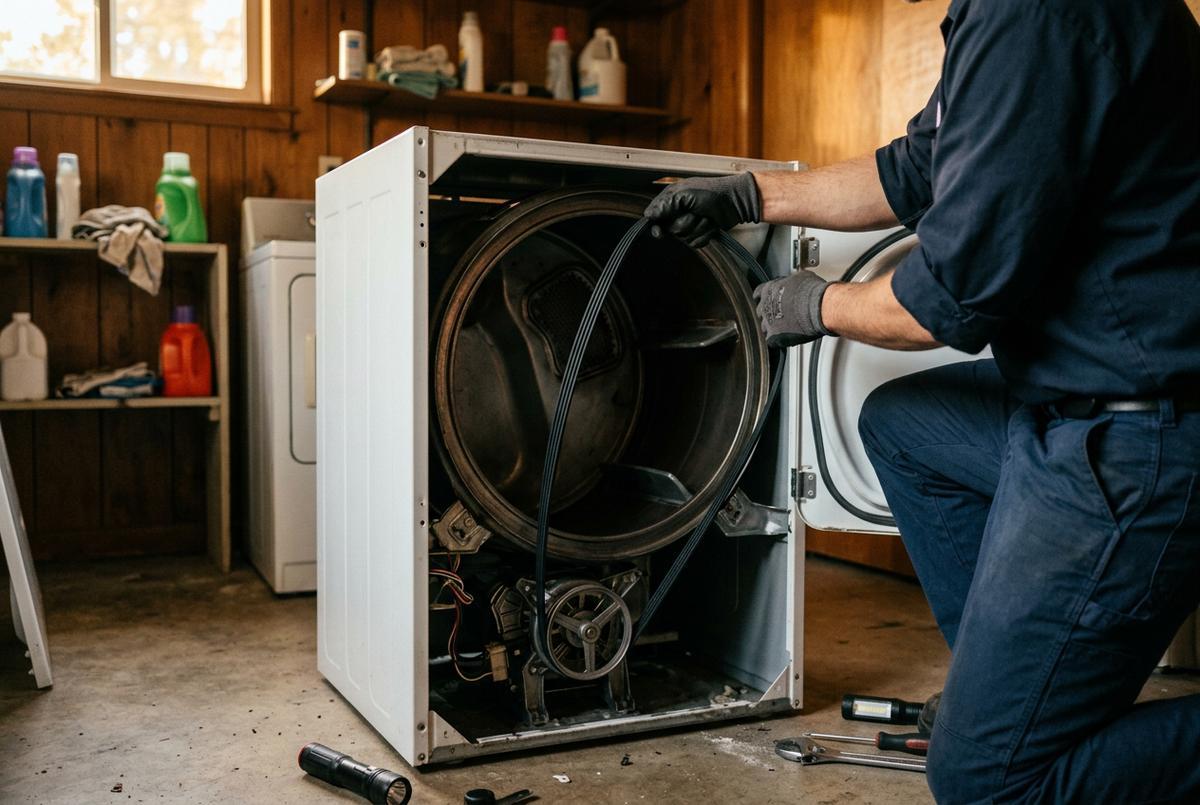
We repair dryers that won't heat, won't spin, or shut off mid-cycle, and we work on all major brands as an independent shop. Call us and tell us what you hear or smell. Dryers fail in predictable ways: heat disappears and loads come out damp, a snapped belt leaves the drum sitting still, thermal fuses blow after years of lint packed into a long cramped vent run. Motors whine, rollers flatten, door switches stop registering. On a visit we open the cabinet, check the heat circuit, spin the drum by hand, meter the fuse and thermostats, then follow the vent path start to finish, because a good machine on a blocked vent still fails. Most of our work happens in basements, stacked closets and second-floor laundry nooks, so tight access is normal for us.
Call (888) 826-9217- A real person answers
- Open 7 days
- Written quote before work starts
Taking calls until 5:00 PM ET
The dryer symptoms we hear most
- "It runs but clothes come out wet" No heat: blown thermal fuse, failed heating element, bad thermostat, or a choked vent line
- "Something's screeching in there" Worn drum rollers, a dry idler pulley, or a bearing gone rough at the rear of the drum
- "The drum won't spin at all" Snapped drive belt, seized pulley, or a motor that hums and stalls
- "It shuts off after ten minutes" Overheating from restricted airflow, or a moisture sensor and control board reading wrong
- "Won't start when I press the button" Door switch, start switch, thermal fuse open, or no power reaching the control
Safe things to check first
Worth a look before you call — sometimes it saves you the visit.
- 1Pull the lint screen, rinse it, and hold it up to the light to see if water beads instead of passing through.
- 2Open the door and press the switch plunger with your finger. You should hear a distinct click.
- 3Go outside and check that the vent hood flap opens with airflow and isn't packed with lint or blocked by snow.
- 4Reset the breaker for the laundry circuit once. Electric dryers use two legs, and losing one kills heat but not the motor.
How an independent local shop compares
| Elite AR | Big-box repair chains | Handyman listings | |
|---|---|---|---|
| You approve a written quote first | ✓ | ✕ | ✕ |
| A real person answers, 7 days a week | ✓ | ✕ | ✓ |
| Gas and electric, all major brands | ✓ | ✓ | ✕ |
| No manufacturer targets to hit | ✓ | ✕ | ✓ |
| Crews familiar with homes like yours | ✓ | ✕ | ✓ |
What homeowners say after the visit
“Dishwasher stopped mid-cycle full of water. They walked me through draining it on the phone before the visit even happened.”
Carl H.Toms River, NJ“Straightforward people. The written quote made the decision easy.”
Monica T.Nashua, NH“Fixed the ice maker and showed me why it jammed so I can stop it happening again.”
Ray S.Brooklyn, NYDryer Repair — quick answers
Why is my dryer taking three cycles to dry one load?
Almost always airflow. Lint collects in the duct, the hood flap sticks, or a crushed flex hose behind the machine strangles the exhaust. Heat builds, the dryer cycles off early, and clothes stay damp. We check the whole run, not just the screen.
Is a burning smell an emergency?
Treat it that way. Stop the dryer, unplug it or shut the gas valve, and don't run it again. Scorched lint near the element smells like that, and so does a failing motor. Call us and we'll talk through what you're smelling.
Do you work on gas dryers as well as electric?
Yes. Gas units add igniters, flame sensors and gas valve coils to the list of parts that fail. Electric units come down to elements, fuses and thermostats. We diagnose both, and we handle stacked and side-by-side setups.
My dryer is twelve years old. Worth fixing?
Often, yes. Belts, rollers, fuses and elements are ordinary wear parts on a cabinet that's otherwise sound. If the drum is cracked or the bulkhead has rusted through, we say so plainly and you decide.
Can you reach a dryer in a tight second-floor closet?
That's routine work here. Older homes in this region put laundry in hallway closets and back stairwells. We bring what we need to slide, tilt and service a machine without space to walk around it.
How long does a typical dryer repair take?
Most single-part jobs (belt, roller, fuse, element, door switch) finish in one visit once we've confirmed the diagnosis. If a control board or blower housing has to be ordered, we schedule the return and explain what happens next.
How it works
- Step 1
Tell us the symptom
Call us or fill out the form and describe what you hear, smell or see. Brand and rough age help. We ask a few questions first so the tech shows up with the likely parts already on the truck.
- Step 2
We come look
Pick a window that works for you. The tech tests the machine and checks power, water and drainage, then tells you what failed in plain words. No jargon. No guessing out loud at your kitchen table.
- Step 3
Repair or straight answer
Most jobs finish on the same visit. If a part has to be ordered, we tell you what it is and why. And if the unit isn't worth fixing, we say that, then you decide.
- A real person answers
- Open 7 days
- Written quote before work starts
Why homeowners call us
- Old houses don't scare usRowhouse kitchens, narrow cellar stairs, stacked units jammed into closets. We've pulled machines through doorways built long before these appliances existed. We protect floors and trim, and everything goes back where it stood.
- Symptom-first diagnosisA dryer that runs cold and a dryer that trips the breaker are two different problems. We test before we replace. That keeps us from swapping out good parts and handing you a bill for nothing.
- Independent, not a brand agentWe repair all major brands and answer to no manufacturer. So we recommend the fix that makes sense for your machine and your budget, and that includes telling you when replacement is the smarter move.
- All major brands, gas & electricIndependent service on Whirlpool, LG, Samsung, GE, Maytag, Bosch, KitchenAid and the rest.
- Straight answersNot worth fixing? We say that out loud, and often it saves you the visit fee.
Dryer Repair
Small faults become big ones on a schedule of their own
Describe the symptoms and we'll book the visit — takes about a minute.
- A real person answers
- Open 7 days
- Written quotes
- All major brands
- Gas & electric
Rather not call? Get a free quote →